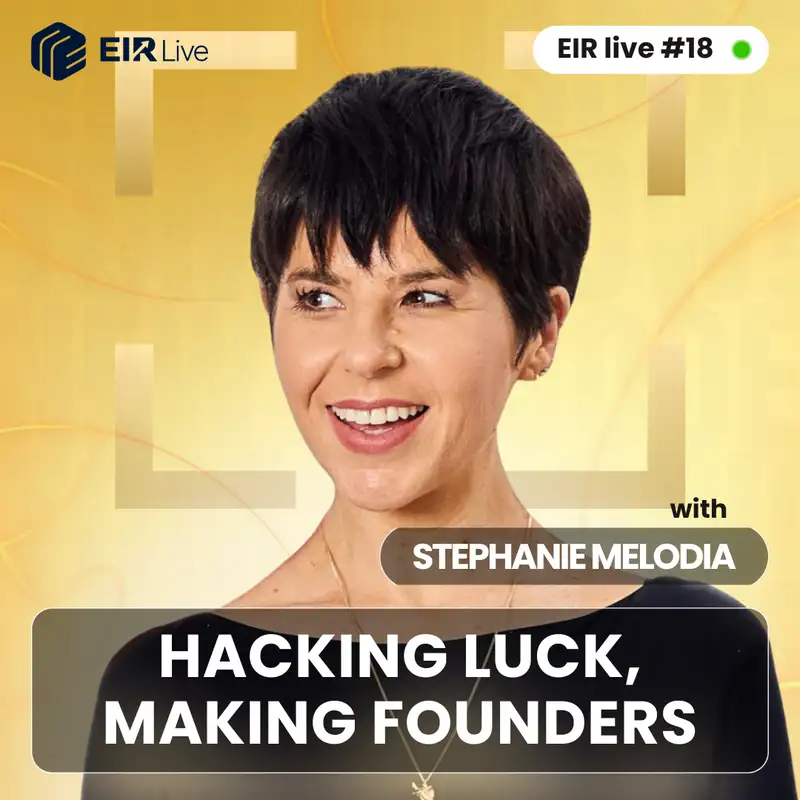
Episode 18 - Hacking Luck, Making Founders with Stephanie Melodia
The truth is actually it's not the harder I work, the luckier I get. It's the more risk I take, the luckier I get. And so that's something that entrepreneurs are better at than anyone else. It's taking risks. It's actually having the stomach to do what other people won't.
Stephanie Melodia:When you can do that, you are already head and shoulders above the rest.
Ilya Tabakh:Welcome to EIR Live, where we dive into the lives and lessons of entrepreneurs in residence. I am Ilya Tabakh, together with my cohost Terrance Orr, ready to bring you closer to the heartbeat of the innovation entrepreneurial spirit. Every episode, we explore the real stories behind the ideas, successes, setbacks, and everything in between. For everyone from aspiring EIRs to seasoned pros, EIR Live is your gateway to the depth of the entrepreneurial journey and bringing innovative insights into the broader world. Check out the full details in the episode description.
Ilya Tabakh:Subscribe to stay updated, and join us as we uncover what it takes to transform visions into ventures. Welcome aboard. Let's grow together.
Terrance Orr:All right, welcome back to another episode of EIR Live. I'm here with my good friend, Steph. Thank you for calling in and joining us all the way from The UK. All right, we're in for a treat today and Steph and I, it's kind of interesting because we were in the trenches together at this incredible organization called One Day. We're literally, we're trying to shepherd in the next generation of entrepreneurs and founders and help them build companies from zero to one.
Terrance Orr:And oddly enough, Steph had the privilege to interview me a while back on one of the one day podcast episodes in Firesides, one of many of things that we got a chance to do together and I just love her energy, her knowledge, her insight and I thought that it would be great if I could have her on our podcast Ilya and so I'm glad she said yes and I'm glad that she's here today and I can talk a long time about Steph but hopefully I'm gonna give her the privilege to introduce herself and her background because I know she's gonna give it the right amount of time and shine that it deserves. So, Steph, if you can introduce yourself, that would be incredible.
Stephanie Melodia:Thank you so much, Will. The privilege and honor is all mine. Thank you for having me on your show. I'm so excited we're making this happen. Well, I guess I'll kick off from what you've already mentioned, which is our connection both as mentors, faculty members on the MBA programme for entrepreneurs.
Stephanie Melodia:We are not on commission, although we should be, but if anyone is thinking of exploring entrepreneurship, I definitely think, especially if you've had what I like to call the first pancake, which is you scratch the itch, you've had your taste of entrepreneurship and you've seen firsthand just how difficult it is, just how unglamorous it is, then one day is a fully credited eighteen month programme. I'm heading into elevator pitch at the moment. But it is genuinely awesome. And for me, what definitely sold it when I joined as a mentor a couple of years ago now is the fact that you actually start and scale your business for real alongside the programme. So, I always tell people your weekly homework is literally to take action on the business.
Stephanie Melodia:So, that's one of the many reasons why I love it. I am also a big sister in real life and I do feel like one day has given me the opportunity to be a professional big sister. So I absolutely love it. That's our connection point. That's one of the hats that I wear.
Stephanie Melodia:One of the other hats that I wear to do the rest of my introduction is I am a professional public speaker, which I feel always raises the bar unnecessarily when I'm doing these podcasts and things because it's like, okay, now she's going to be like pitch perfect. She's not going to do any umming or ahhing and be this perfect public speaker. But genuinely, I absolutely love what I do. So, I travel the world delivering talks, trainings. I'm actually going to be in The US later next month, July.
Stephanie Melodia:I'm not sure when this is coming out. My subject matter expertise is of course around entrepreneurship, growth. I've of course run my own businesses, as well as mentoring on the One Day program and privately coaching some one to one founder clients. But my signature topic, and I think this is where I'll leave my meaty intro, is something called Hacking Luck, which we can talk about a little bit more, but that's basically my number one hit. That's my Katy Perry, I Kissed a Girl was hacking luck.
Stephanie Melodia:So, I'm going to leave it on that note and we can dive into the conversation.
Terrance Orr:Love it. Thank you so much for sharing more about your background and they're definitely going to learn a lot more because they're going to ask you a million questions. And the bar is very Very, very high. Okay? But I want to start from the Ground floor.
Terrance Orr:Okay? Because something that we love to do in the podcast is taking it back just a little bit to figure out how did you actually get here? Today, you're the keynote speaker, the entrepreneur, helping founders with growth. But you didn't start here. It started in an art school.
Stephanie Melodia:Yes.
Terrance Orr:A long time ago. So talk to us about take us back to art school a little bit. I
Stephanie Melodia:am so happy you've decided to start the story there. Whenever I get interviewed in another podcast, where do we start? And I'm like, well, I can take you as far back as you want to go and I've got tons of stories. But let's kick off with the art school. I'm very happy you say that.
Stephanie Melodia:Because I always say that my first proper business was a marketing consultancy I started in 2017. And the reason why I call it my first proper business is because sneaking into the basement of said art school to screen print T shirts, model them on my little sister and flog them on a Facebook page. Doesn't quite count as the proper business when I was like a teenager. So, I love that we start the story there because clearly there is already this entrepreneurial itch. This is going quite a way back as well.
Stephanie Melodia:So, this is before entrepreneurship was really a thing. It wasn't glamorized. If you'd asked me at that point to name an entrepreneur, I'd say Richard Branson, he'd probably be the only name that would come to mind. Without that social media allure, without these best selling books and these images of these entrepreneurs, this is before Silicon Valley and all the rest of it, right? Clearly there was that natural inkling that I already had.
Stephanie Melodia:I believe that going to art school, for me, the definition of entrepreneurship is creativity plus freedom in servitude of a market need. So, I definitely had that creativity part, right? You want to produce something, you want to create something. So yeah, I had a ton of fun. Not only was this just a random art school, but this was also an art school on a desert island.
Stephanie Melodia:So I grew up abroad. I have a very unique story and this is also where it links in to my signature talk of hacking luck because in many ways I am incredibly lucky. So, I'll pause there because I don't want to tell any more stories of my art school days, I'll probably get in trouble.
Ilya Tabakh:I want to jump in there for a second. It's funny because a lot of folks that we talk to do have these, you know, early, formative, wanted to build something, get into something, and and often that that you sort of you sense a little bit of this downplay of, well, it wasn't a proper business, whatever. But Yeah. It's actually really funny because when I talk to, you know, sort of later stage kind of entrepreneurs and folks that are thinking about it, everybody wants to do like this meaty business canvas or business plan or, you know, this tome of how the world works in their business world. And a lot of the time, it comes down to, hey.
Ilya Tabakh:What are you selling that people wanna buy? Are you producing it for less than it costs you to, you know, that can you make a margin? And are you able to collect the money, you know, before you sort of need it? You get a lot of those kind of basic tactical things in in, you know, sort of running exactly what you're talking about. And it's Yeah.
Ilya Tabakh:I I just always find it kinda funny that that folks are, you know, sort of humble about these beginnings. But I think developing a lot of the kinda instinctual tactical things is is maybe the difference between a philosopher and a practitioner.
Stephanie Melodia:I do think, you know, I've alluded a couple of times to the glamorization of entrepreneurship already in the conversation. And I do think I'm not gonna come on here and like bash social media or whatever. Like, it has its pros and its cons. I do think one of the downsides to it has been this immense pressure, especially with this idea of building in public, the idea of having a personal brand, the fact that people now know me, they know my story. So, now it's you get the thriller effect where you're like, Shit, well, my next business has got to be even more successful and even bigger.
Stephanie Melodia:It's just this external pressure that's put upon us. Actually, thought to myself, I'm like, Can I just go and I'm so tempted to go off and build these other things that like no one needs to know about? Like I'm not going to splash about it on LinkedIn. I just want to do something like over here on the side that isn't getting all the press, but exactly to your point Ilya, that just like has those basics, it's profitable, it's revenue generating. I think linked to that social media pressure is good and bad as well.
Stephanie Melodia:I've seen these incredible phenomenal success stories. But again, being so close to it, eating, living, breathing it from so many different angles, literally every single day, it's hard to temper that inspiration with the scepticism because you just know too much, just know how hard it is. And you think sometimes, you know, ignorance is bliss and it is nice to look up to these incredibly successful examples to like, if that's what gets your fire going, then more power to you. But like when you say like top 1% or top 0.001%, it's like, that's real. Even just with venture capital, we can talk about that view.
Stephanie Melodia:It's like I was a scout for many years for a VC firm and like I felt the rejection vicariously of the companies I was trying to get funding for. It's crazy brutal. But the thing is, think there's people don't always believe it and it's like you don't really believe it until you get to experience it yourself. So
Ilya Tabakh:Yeah. That makes that makes sense and it's just interesting kind of that that dynamic because I think the the back and forth between, you know, who you building for falling in love with the problem, a lot of the sort of dynamics that I hear kinda baked in there would be good. May maybe one thing to sort of continue this where you got started. You you said art school, desert island. I think it was also like a multilingual situation.
Ilya Tabakh:Yeah. It it seems like there is sort of a lot of diversity. Did that teach you about hustle? What are the takeaway lessons from that foundation story for You
Stephanie Melodia:guys are asking me all of my favorite questions. Honestly, is such a treat. I'm so excited with like every question you ask me. That's such a good one. I honestly believe that we all, every single one of us, have 100% choice over how over our perspective, over how we want to view certain life situations.
Stephanie Melodia:We are the stories that we tell ourselves, right? And so for me picking and choosing the lessons learned, what set me up for success, there is one argument to say, like how bloody useless is an art school degree? It's like that didn't launch me off into this lucrative high paying career, right? I also specialised in illustration. That's just a fancy word for drawing.
Stephanie Melodia:I got to sit around and just put pen to paper and listen to Nine Inch Nails in the background. So for me, genuinely, genuinely, I mean this with all my heart, one of the biggest, most wonderful gifts that that experience gave me was the attention to detail. That's like a huge, huge thing because we can all obviously see, right? Like Ilya, I can see your gorgeous bookshelves in the background with like dolls and books in the ball. Terrance, I can see you've got some frames, but like if you have to suddenly now like sit down and draw or paint what you're seeing, suddenly now you've got to be like, oh, okay, it's like a yellow head, it's got a red hat, it's just like next level, it's just next level in terms of that attention to detail.
Stephanie Melodia:So, I think that's definitely one thing that's given me an edge. But I think more relevant here to your entrepreneurial listeners is you mentioned Ilya one of my favourite words, hustle, favourite, but also Marmite term, right? Definitely hustle, definitely. I don't know if any of you, if your listeners will know the film or if you guys know. Have you both seen Catch Me If You Can?
Terrance Orr:Mhmm. Yes. It's a good movie.
Stephanie Melodia:Yeah. Great movie. Honestly, how did it take Leo that long to win an Oscar? That's a whole other conversation. So, if you guys have seen the film, then you'll likely remember the scene where Christopher Walken gives that monologue at the award ceremony and he talks about two little mice, they fall into a bucket of cream and that set the first mouse quickly gives up and drowns and the second mice turns that cream into butter and he walks out.
Stephanie Melodia:So, there are these moments in popular culture, whether it's scenes from films, lyrics from a movie, whatever that really resonate and really stick with you. Clearly here I am years later, like recounting that scene from that film. So I don't really come from much, right? I'm not going to do like poor little me violin or anything like that. But I did grow up on a very small desert island.
Stephanie Melodia:My parents made a ton of sacrifices to give me and my sister a good education. But leaving that island to come to London via Toronto, which is another story. But to come here with no university degree, no connections, no inroads, nothing. By the way, the money that I had linking it back to art school and what I got from that came from competitions that I won from these little drawings that I was doing. So I was entering competitions, I won all of them, which is humble brag.
Stephanie Melodia:But like I'd go one of this money and that the money I had, like self made at literally 18 years old. Like no one gave me the money or anything. I came here and honestly, this is the last thing I'll say and we keep the conversation moving. But genuinely guys, I remember first moving to London, if anyone knows the city, I flat shed the spare bedroom, which we talk about like a shoebox bedroom. This bedroom was tiny, tiny, teeny, teeny weeny.
Stephanie Melodia:I had a tiny single bed. I was in Zone 4, which is like not even London at that point, right? Like it's all like so far in the outskirts and I perf- I'm going to break this down and be super transparent. My take home pay from this job that I got was £900 after taxes. So dollars, what would that be like?
Stephanie Melodia:$1,200 $1,300 I'm guessing?
Terrance Orr:1,300, yeah.
Stephanie Melodia:Something like that, right? So let's do this in dollars. So like $1,200 after taxes, my rent for the shoebox room was, I just remember all the financial breakdown. It was £400 so like $506,100 dollars So that's like half my paycheck. Because I was living out in Zone 4, I had to have a travel card that was like another £200, $350 on top of it.
Stephanie Melodia:Guys, I hate to say this, but like I was sneaking toilet rolls in my handbag from the office. I was boiling pasta and like living off of that from Tesco's, right? And so that's why linking it back to, you know, that Christopher Walken monologue from the film is like, that's where it really resonated with me because, you know, building something from nothing, again, I'm not going to say like for fully like rags to riches here, but very self made in that way. And I think if you guys will allow me, is the perfect segue actually into Hacking Luck. Should we go there?
Terrance Orr:Of course we need to go there, right? And I think it's only right that we go there but there's a few things that I wanna comment. I think this is where real entrepreneurs are made, right? When they're forced to adapt, when somebody put them in a new scenario that they're unfamiliar with and they have to get familiar, they have to get familiar quickly and they have to find a way to feed themselves, Period. Right?
Terrance Orr:Exactly. I think there's something about people who can find a way out of nothing, you know, to feed themselves. And it is sort of the infrastructure I think to, you know, entrepreneurial spirit and being able to build something from nothing. And what you just described to us is that exact same story, right? And there's something to be said about the hustle that you have.
Terrance Orr:I think people who have a legacy that they want to build, hustle for their last name and not their first, right? This is the real thing that we're talking about here. You know, so let's talk about how you decided to, you know, make this pivot and how you started to hack luck, right, into the world that you're in right now. Talk to us about that.
Stephanie Melodia:Love this. Now, the reason why this is the perfect segue, talking about hustling, effort. So, I usually begin my keynotes with a question out to the audience. So, as much as I'm a public speaker and I can talk for England, obviously, I always want to have that interactivity with the audience. I want that feedback.
Stephanie Melodia:So, whether I'm addressing an audience of 10 people or 10,000 people, right? The first question I put out there is, what do you think matters the most? And you guys can answer this too, and listeners, have a think as I put this question out there. What do you think matters the most when it comes to achieving any type of success? Talent, effort, or luck?
Ilya Tabakh:Balance.
Stephanie Melodia:Okay, Ilya says balance. I don't think I've heard that one before, so go you. Terrance?
Terrance Orr:Look, I think a hard work beats talent, right? When talent don't work hard, right? So I don't think it's talent. I think I know a lot of people with talent who not as wildly successful as they want to be. But I do think luck is where opportunity meets preparation, right?
Terrance Orr:So I'm not answering your question directly, but that's what I'll say as a comment.
Stephanie Melodia:Well, you know what, I'll give you half a point and it's actually really interesting kind of anecdotal quasi research piece when I put this question out there because across different audiences, whether it's conferences or private client events, again, varying audience sizes, it's actually really interesting to see what people answer. And that's why I wanted to make sure you guys could answer me as well, right? I'm always so curious. So, the majority of hand raised answers to that question is effort. So that's where Terrance, I'm going to give you half a point there.
Stephanie Melodia:Spoiler alert, my whole thing is called Hacking Luck for a reason. Because as a young woman in my early 20s that has succeeded in moving from this unknown, unheard of desert island in the Atlantic Ocean to an Alpha plus plus city called London in The UK and built up this career from nothing. I was on a win, right? I was on a winning streak, things were going fantastically, we were getting over the recession, there are all these things where I was like, I put in the hard work and it's working out for me. Again, that Christopher Walken monologue of like, we're turning the cream into butter.
Stephanie Melodia:It wasn't until I got into business that I learned that that effort only takes you so much of the way there. I hit a ceiling and I'll be super honest and transparent with you and your listeners about this. I hit a ceiling with that marketing consultancy, my first proper business that I started in 2017 and grew from the ground up. But really what I succeeded in doing with that hustle spirit was honestly working my day job so hard that I built a business around it. This is where I was just going down some rabbit holes a while ago.
Stephanie Melodia:This was about a year ago and I stumbled upon this amazing research by Daniel Kahneman that maybe your listeners have heard of. He did this research that looked into asking exactly this question like talent, effort, luck. Most people do get it right that talent is the bottom of the pile and spoiler alert, what I share in my keynotes is this really funny clip of Ed Sheeran where he's on a chat show and he plays this clip of him where he's like, Oh, everyone thinks I'm so talented, I'm so successful. But he plays this clip of him performing at the beginning of his career and it is terrible. It's terrible.
Stephanie Melodia:So, people can't believe that this is this incredibly award winning artist. So, you're totally right Terrance, effort talent every time. But what beats effort? It's almost like a game of paper, rock, scissors, right? But luck has much more of a bearing on our success or failure than we like to think.
Stephanie Melodia:And I say than we like to think because nobody and especially entrepreneurs like to feel that they don't have control. So, there is this neuroscientific concept called SCARF that we all have, as in like a scarf that you wear. And the C, I won't go through all of them, but the C in SCARF, it stands for certainty. We all crave certainty. We don't have to be control freaks, but we like to feel in control.
Stephanie Melodia:Again, as entrepreneurs, we like to feel that if we put in the effort, if we hustle hard enough, we can build this business. It's simply not the case. Now, effort is a close second place and I think that we're emerging from this era of productivity fetishization, right? Like, we fetishized productivity. There have been so many hacks and books and tips and tricks on maximizing your productivity.
Stephanie Melodia:But the reason we need to have this conversation now is of course the hottest buzzword in 2026, it's AI. We are not playing games that we can win when AI is in the equation because AI is going to run circles around us in productivity and already has. And so what do we do instead? We're now rewriting these rules of how do we find success and meaning and purpose and motivation when we can't compete against AI? And that is where hacking luck comes into the picture.
Ilya Tabakh:Well, I'm just you there's so many things to unpack there. I just kinda quick Quickly yeah. Quickly jumping in. You know, I think I'm glad you brought up AI for kind of sheer productivity versus not. But even in sort of thinking about humans and AI systems, you hear the word taste come up a lot.
Ilya Tabakh:Right? And as an artist, I think you'll appreciate this, you know, maybe more so than other folks that I bring it up with, but there there's sort of this rebalancing. And it's actually funny because in my sort of computer engineering, computer science background, I entered the field at a time where we were operating in a world of constraint and maybe less constraint than was the case in the fifties and sixties. But still, the question was, you know, what should it wasn't what should we compute. It's what can we compute with the, you know, time and resources and whatever that we have.
Ilya Tabakh:Right. And and and in my professional career, that's that's pretty inverted, you know, and I got to early in my academic work ask, what if we could ask what should we compute, not just what can we compute, how would we do it differently? But I think that, you know, sort of that that taste and even a little bit of the muscle memory we were talking about from, you know, starting young develops that taste as well. You know, in in our prep call, we were actually talking about some phrases that, you know, mirror your hacking luck. For me, it's always, you know, luck rewards the prepared.
Ilya Tabakh:And and and so there seems to be, at least from my perspective, a little bit of a balance between, you know, sort of that that triangle of talent, effort, luck, and then ultimately your ability to develop taste and, you know, move faster, smarter, kind of refine your heuristics, things like that. So I just don't wanna Yeah. I I don't wanna sort of make them completely independent properties in this conversation and it's kind of the thing that stuck out.
Stephanie Melodia:It is rewriting the rules across every single playbook. And I think this is again, we're now like speaking to so many people, whether it's entrepreneurs, employees, and organizations, everyone is trying to we're all finding our feet, right? We're all like, how do we still have an edge as humans? How do we operate? What gives us purpose and motivation when I could just hit this button and like Claude can go and run this?
Stephanie Melodia:It's like, okay, that's my day job. And it's like on a deeper level, that's super demoralizing, right? You're like, okay, guess, you know, everyone wants to be needed. Everyone needs a reason to get up
Terrance Orr:in the
Stephanie Melodia:morning. So again, this is where kind of hacking luck comes into the equation.
Terrance Orr:So Steph, talking about sort of hacking luck, rewriting the rules, constraints leading to creativity, right? Advice would you give to our listeners, right, who's thinking about rewriting the rules in their own life, in their own journey, like in the simplest form, right? Where would you tell them to start or what questions should they be asking themselves right now to start thinking about that?
Stephanie Melodia:Great question. So we've already mentioned a couple of like the cliches, the quotes, the one liners related to luck, right? There's loads of them out there. And like Ilya, you said, luck fortunes the prepared, luck is when preparation meets opportunity. One of the other famous quotes that gets repeated over and over, and especially when I tell people this is like my thing, is the harder I work, the luckier I get.
Stephanie Melodia:And this comes full circle back to that entrepreneurial hustle and the first part of our conversation. My advice or the question I would invite your listeners to ask is the truth is actually it's not the harder I work, the luckier I get. It's the more risk I take, the luckier I get. And so that's something that entrepreneurs are better at than anyone It's taking risks. It's actually having the stomach to do what other people won't.
Stephanie Melodia:When you can do that, you are already head and shoulders above the rest because most people, again, I mentioned before, we crave certainty, we crave that safety. We want to know that we've got a paycheck coming in at the end of the month, we want to know what am I waking up to in the morning. But something else that I joke about is the resilience of a millennial. The resilience is one of the core, the eight core principles which I can break down for your listeners. But like, you know, I woke up this morning to the news that our Prime Minister has just resigned.
Stephanie Melodia:And it's like, and I also woke up to the news that a CEO, an influential CEO in Austin, very sadly, tragically has died in a plane crash. And like this is today, and someone else told me one of the this is really dating the episode, so apologies guys. But someone else told me one of the formal federal chairs has died at the age of like this is just today, right? But like zooming out my point is that as a millennial, I've lived through four once in a lifetime recessions, multiple black swan events. Began my career at the tail end of the last recession that is literally in economics history books and I lived through it.
Stephanie Melodia:I know the 'eight crisis, was there. So, need there's that pairing there. I also about the R and R, it's not rest and retarget, it's the risk and resilience. You have to take risks. Everyone's got their own risk tolerance.
Stephanie Melodia:I have an assessment framework to really practically work out what's your risk score because whenever we do our personal finances, if we see a bank manager or financial advisor, they do a personal risk assessment on our finances. So, why don't we have that as individuals, as teams, as organizations? So, I have this risk assessment framework to look at, you you don't need to be this like venture backed founder who's betting their whole house on this business. It's super relative to each individual, but that's ultimately my answer, my piece of advice. It's not the harder you work, the luckier you get, it's the more risk you take.
Stephanie Melodia:And so ask yourself, what's a risk that you can take today, tomorrow, big or small?
Ilya Tabakh:Yeah. It's I gotta I gotta jump in for a second because I I sort of have a a parallel or orthogonal view to you. I always use sort of the surfing analogy. Right? You need to sort of build skills and and be ready to surf, but without a wave, there isn't much surfing.
Ilya Tabakh:And so it's a little bit of a timing, a little bit of a luck, but also preparation and and sort of those two things. And and I think it's it's sort of saying some of the similar things you're saying, but maybe in, like, a little bit of a different way.
Stephanie Melodia:Yeah. I think, like, this is a really fun conversation because you're definitely making me think about this as well. Like, I would potentially argue that that risk tolerance is creating the wave. There are so many different waves you can catch. And by taking these risks, it's almost like you're not just sat on the beach with your surfboard and I love that analogy, but taking risks mean that like, imagine we're- to continue the analogy, imagine we're sat on the beach and there's various tugboats coming in and out of the ocean and maybe there's a big cruise ship that comes in.
Stephanie Melodia:There's all these other things that can say, hey, you don't just need to sit around on this beach waiting for the next wave. Like, if you come out like 10 meters out that way, a 100 meters out that way, like, there's these other waves you can catch, would be my take.
Ilya Tabakh:Yeah. No. Awesome. And and and the other thing I share with folks is the way that you figure out how long you can stay in the game, the longer you stay in the game, the better chance you have. Right?
Ilya Tabakh:Which is sort of the Yeah. The secondary, and that gets back into being intentional. You know, I've I've actually my my best advice on this is entrepreneurship is really more of an apprentice sport, that there's a lot of things that you can learn and that are out there, but they're not sort of well packaged typically. And I think there are definitely things like you're presenting and and other things that are out there where people can catch a glimmer, but I think having a little bit of being able to use somebody else's taste and perspective to sort of accelerate your own thinking is is a huge deal in these kind of conversations. Day.
Ilya Tabakh:Yeah. Right. Right.
Terrance Orr:You know, I I love this because it what what it all about boils down to is if we're using your analogy, Ilya, around surfing, for example, like, there's no ways, you still have to get on the board, right, and get in the water, right. You still have to try essentially, like I truly believe entrepreneurship is a contact sport, you have to be in the game, you know, in order to even know if you're gonna fail if you're taking something. So I like to tell people that a lot of times people ask people, Terrance you've done so many things, how do you pick what you're gonna do essentially? How do you know what risk to take? And I tell people I run towards the thing that I'm most afraid of, right?
Terrance Orr:And because I feel like if it's in my comfort zone, it'll feel too easy to me and I want some level of something that's going to stretch me a little bit where I'm taking a little bit of risk, you know, or maybe moderate risks. And I think that those are the opportunities that tend to start to create this luck around us, where you meet somebody new like Steph at one day or, Ilya when I decided to send him a message on LinkedIn to say, hey, you're EIR, you're talking to a lot of EIR's like, all of a sudden we're doing a podcast together, right? So this idea of like, you have to get in the game, you have to shoot your shot, you have to try to start to hack luck a little bit, right? And I think that's, we're talking about that in many different ways here, so anyway.
Stephanie Melodia:Yeah, a 100% and not to overreg the One Day program too much but I really admire the founder. I think he's super inspirational and part of his argument for starting One Day the company was because he did actually, I don't know if you know this Terrance, but he actually did go, he signed up to an entrepreneurship course and it blew his mind that the professors were teaching this content without ever having run their own business before, to your point on it being a contact sport. And I'm just going to continue on like the film references for a sec because literally just the other night I rewatched Cocktail of the 80s Tom Cruise classic. And there's this scene, I didn't remember this, but there's this scene where he goes to school and he wants to be an entrepreneur and he's reading all these books and he goes to school and he's learning economics and he says this in the scene, he's like, Why should I be taking advice from you? You're a professor, you've never operated in the real world.
Stephanie Melodia:So, I think that does not only speak to the one day programme, but if you're looking for coaching, mentorship, which I have a few private clients, it's like, you've got to be working with someone who's done it before, who has been a player on the field and not just a spectator of the sport.
Ilya Tabakh:My I gotta since we're doing movie quotes, my my favorite one to that one is in Good Will Hunting where they're talking about, you know, sort of knowing versus being very smart, that kind of thing. And, you know, Matt Damon's character is telling the story about, you know, how all this stuff works. And Robin Williams' character comes back and this is like, look. You can tell me all these things, but if you haven't been in the Sistine Chapel and you don't know the smell, then you really can't talk to me about it. Right?
Ilya Tabakh:And there's just like a really good clean way of distilling that, you know, and so it a little bit to taste and experience as well. Exactly.
Stephanie Melodia:It does link it does link back to AI, isn't it? It's like symbolic knowledge where it's like, you're saying things that sound right and it's kind of it's almost like this imprint, isn't it? It's like, okay, I've like absorbed this information, I spit it back out. But yeah, to your point, you haven't had that lived experience, whether it's smelling the Sistine Chapel or playing a contact sport, to use Terrance's analogy. You
Terrance Orr:know, I'm curious because we love to ask this question, is, before you ran across one day, right? Have you ever heard of the concept of entrepreneur in residence before you became one essentially? And how did you hear about the opportunity? In the context of one day, it is you are mentoring founders. In other other scenarios, you will be starting a company from zero to one.
Terrance Orr:In another scenario, it's out of depending on your residence, the role of an entrepreneur in residence will change essentially. So when was the first time you heard of this mysterious word of an entrepreneur in residence? What made you want to go and do it?
Stephanie Melodia:Yes. So Terrance, you really got my cogs turning on that because I was like, initially I was like, had I ever heard the time before I actually had to stop and think about it? And actually, the answer is yes, I had, but I only met one person before, like a few years before. So, I've only got one reference point of an EIR and obviously the first time I heard, I was like, wow, that sounds like such a cool job because I know, again, is full circle back to my art school training. If I get to live to being very gray and old, then my dream as a very, very old lady is to be an artist in residence at a hotel.
Stephanie Melodia:So, always had heard of that term. I was like, that sounds amazing. I really look up to an illustrator called David Downton, who's the artist in residence. It was the same the way I first came across that term for a really posh hotel here in London. Was like, that's amazing.
Stephanie Melodia:And so I gleaned from that terminology like what it meant. But really, I know it's rare because I've eaten, live, breathed the world of startups and entrepreneurship over the past decade plus. So, it was actually a client who was an EIR at an incubator. It was a corporate backed incubator in the automotive sector. And that was like, I was so impressed.
Stephanie Melodia:Like it really kind of blew my mind. I was so impressed that this massive automotive company had this like innovation arm that they were still exercising that entrepreneurial nature, trying out new ventures. And they weren't just sat on their laurels just flogging these cars. They knew that EVs were coming, different types of commoditized insurance, all these other things in the automotive space. So, that's where I first met an EIR.
Stephanie Melodia:What was the other part of the question there, Terrance?
Terrance Orr:No, just sort of what made you you were intrigued by it, obviously. So you decided when you heard about this thing at for one example, just decided to, you know, I'm gonna go for it because I wanna mentor the next generation of Founders, one. But two, I mean, it sounds like a pretty cool thing to go and do. I know my first thought was, Oh, what the hell is this thing? And like, what am I actually gonna do?
Terrance Orr:And I had to move to Silicon Valley to become an EIR. So I was like in the belly of the beast when I first became an EIR. And it was like, oh, you know, you're in the heart of it. So, but I had no clue what the hell I was gonna be doing. So
Stephanie Melodia:Love that. Love that. I think, again, I would connect it back to my role as a big sis, like, IRL, like, in real world. And I know that of all the different roles that we have in life, daughter, partner, boss, whatever, being a big sister, even though I'm smaller than her, so she calls me little big sis, is really where I just feel the most natural, like I'm helping the most. And so I knew that there was that element of being I like to think of it as being a professional big sis, like you're a big sis in business and that's where I love all the founders I get to mentor, but the ones who are like, it sounds obvious, but the ones who are like me, like five years ago, I'm like, I got you.
Stephanie Melodia:You know, like, I got you. These are the landmines to look out for. This is what's around the corner. Don't do this, don't do that. Like, I feel very like, my advice I can give with, like, utter conviction.
Stephanie Melodia:So, yeah, getting to be a professional big sis is why I love being an EIR.
Ilya Tabakh:It's interesting. So, maybe digging into that just a little bit. So, professional big sister, right? One is having the aspirations of your, you know, little in mind and thinking about what's their intention, where are they trying to go. And then part of it is, you know, I think some of the best advice ultimately lands when instead of saying, hey, you know, Terrance or hey, Steph, here's what you gotta do.
Ilya Tabakh:It's like, hey, when I was in a similar situation or here's how I understand your situation, here's sort of the path forward. And there there is even in that, in sort of the presentation of what does it mean to be, you know, an older sibling sort of providing advice, how can these people sort of take it and actualize it that you have to be kind of intentional about or at least I found that useful for my It's kind of
Stephanie Melodia:so healing because I did a post mortem on every business I run, even if it's just mentally. And it's a healing process, to your point there, Ilya, to be able to turn someone and be like, I have been in exactly this situation. I've been in exactly your shoes. And it's almost like another lease of life. It's like another opportunity.
Stephanie Melodia:It's like, just don't make the same mistakes I did. And so, yeah, it feels like this really kinda healing process.
Ilya Tabakh:Amazing. I mean, we talked about hacking luck a little bit. You know, you had like a a whole chapter or three in between kind of yeah. And we kinda touched on it a little bit as far as kinda marketing firm and things like that. I'm curious how you sort of started to manifest, you know, kinda your framework and some of these experiences before Mhmm.
Ilya Tabakh:You were able to sort of distill it and apply it as as as a structured approach. Because it seems like there's little bits and pieces and glimpses, but I'm I'm sort of curious if you can kinda, maybe point to a couple of things in your journey.
Stephanie Melodia:100%. Yeah, absolutely. So, as I mentioned, it was over a year ago, I stumbled across this research and it was thanks to my public speaking career where, you know, I was almost, you know, forced into looking at like thinking about things differently. I came across something called the Overton Window, which is concepts that are socially acceptable and like how do you push the boundaries and especially coming from the TED Talk perspective as well, where it's like a great TED Talk shouldn't necessarily like teach you something new or make you laugh. Really it should make you just see something like completely differently and like the desired audience outcome from that is like, woah, I never thought about it like that before.
Stephanie Melodia:And so, that was kind of where I almost had like this quasi researcher hat on and kind of going down these rabbit holes and really feeding that curiosity. So it was that first stumbling across that research piece that I came across and I just couldn't stop thinking about it, couldn't stop talking about it and it was so through those conversations, it started to kind of develop and percolate and form. And then, this is where I have an awesome story for you guys because this whole shtick of hacking luck is so crazy meta. You know, like, the amount of things that happen that are super lucky and obviously because it's my thing and I talk about it a lot, I pay much more attention to it and I'm looking for more stories and research to continue to refine and develop my framework. And so, quick story time, February of last year, I got an email that landed in my inbox from someone I didn't know, a name I didn't recognize, and it was the marketing assistant of this innovation consultancy in The States actually, and invited me to be on their podcast very much like this one.
Stephanie Melodia:So I was like, yeah, amazing, sounds cool. Didn't really think too much of it. Was like, yeah, flattered, super honored. So we got a date in the diary. So this is February of last year.
Stephanie Melodia:March, we sit down, we do the recording like this, it's virtual. I just so happened, I swear, I could not make this stuff up, right? I had just posted on my Instagram a Venn diagram of the overlapping of all the components that make hacking luck. So, a lot of the concepts I still have today, so like taking risks, resilience, optimism, being open, like just this visual. And so obviously, like you guys have done an excellent job like doing your research, checking out my online presence, checking out my social media profiles, these guys did as well.
Stephanie Melodia:So I just posted this. So it was the first thing that this guy saw. So the guy interviewing me just like latched onto it. It was just like, this is so interesting. Like it's very refreshing.
Stephanie Melodia:It's so unique. I've never heard of this angle before. And again, the show, their work is very much in innovation, in entrepreneurship. So it was a fun opportunity for him to also, I think, like talk about something else. So we dove into it.
Stephanie Melodia:This was one of the first like proper conversations on the topic. The marketing team then ended up making the whole episode around that. So the title of the podcast episode, like Hacking Luck, the artwork, the social media posts, everything around it. The host of this podcast and I, we just got on like a house on fire. We stayed in touch.
Stephanie Melodia:We kept the conversation going. No expectation, just stayed in touch. So they've reached out in the February. We did the recording in the March. April, this show is released.
Stephanie Melodia:We continue to stay in touch. Few months later, this guy invites me to give a keynote at an event that he's running in the GCC in September. So, I'm like, wow, this is incredible, like incredible opportunity, amazing, yes, and it was just an absolute dream on every single level, right? Did so well, I got the best possible feedback as a public speaker, which is an encore. So I got asked to come back again in November.
Stephanie Melodia:And so that November, I came back again and I was like, wait a minute. And again, this is all on the topic of Hacking Luck, right? The keynote is all about this. So I was like, wait a minute, how cool would it be for me to actually use this, me here now giving this live presentation as one of these case studies. I use myself as a guinea pig.
Stephanie Melodia:And so I'd never gone back to this marketing assistant before but I reached back out to him on LinkedIn. I was like, hey, I'm prepping for this next talk. I never asked you. How did you come across me in the first place? Why did you invite me on your show?
Stephanie Melodia:Because, know, I wanna use this now in part of my presentation. He was like, well, turns out you were a mutual connection of another guest that we had on the show. You've got a profile on LinkedIn, we just love the look of your vibe, you've obviously tick all these other boxes. So, I was like, Oh my God, that's incredible. I had never even asked.
Stephanie Melodia:And so, there's this one slide in this keynote and it really does give me goose palms, it really gives me the feels because it's this visual timeline of this marketing assistant reaching out to me all the way through these points that I mentioned. And then what's so sweet is again, because it's virtual like we, us guys are doing here now. I have the screenshot of our recording and then the selfie that we took in person at that event that we did in September. So, and I never had expected it and it was just such an amazing like full circle moment. And so being able to use that as like this really meta guinea pig case study of hacking luck.
Stephanie Melodia:And so I take this framework, which Ilya in answering your question has been a lot of research, so many incredible Nobel Prize winning papers have been done on the matter, amazing books. I draw from Doctor. Richard Wiseman. I'm still reading. I'm still learning all the time.
Stephanie Melodia:It has all been gradually developed, refined. It's still, it's eating, living, breathing thing, right? Like it's constantly being refined and developed. But what's so great about it is everyone can relate to this in their own. Everyone's got their own stories.
Stephanie Melodia:Everyone can relate to it, whether it's in a business sense or a personal sense. And so, when you take these practical core components, which I can list out so your listeners know, you can then start to see, oh, actually, how have each thing kind of played a part? And so, of course, it's with that understanding, you can then start hacking luck. Appreciate you guys listening to my little story there. That was just like an incredible experience.
Terrance Orr:No, think that's incredible. By the way, just so you know, your episode on this podcast is probably gonna be Hacking Luck. And or something more creative, right, along the way. But I love the hacking luck, obviously. And and two
Stephanie Melodia:Thank you.
Terrance Orr:I think there's it's something to be said about, like, following the thread. Right? You actually answering the emails and following up and and being willing to get on a plane and going to do the thing. But again, it's a contact sport. Right?
Terrance Orr:Nothing nothing happens if you're not also willing to take a leap. I mean, you didn't know them from a can of pay before you met them. Right? You went to the GCC like
Stephanie Melodia:You totally get it.
Terrance Orr:So this is just so important.
Stephanie Melodia:You totally get it. And you're in my head, right? Like that was exactly my September 25, when I'm sat on a Qatar Airways flight to Doha where I've like never been before. I've never met this guy or the team in person before. And here I am not only flying halfway across the world, but getting to the hotel, getting my slides, getting everything ready to arrive at the venue.
Stephanie Melodia:It's like I've travelled all the way from London and I've made it here to the venue early to deliver this talk. You're exactly right. If I can just very quickly list out those eight core components and you can see how this maps on to different situations. So, there are only eight, but it is an A to Z, which has worked out really neatly for my branding brain. So, start with A, which is agency.
Stephanie Melodia:This is really funny where we're in the age of AI, right? We talk about AI agents and everything but we have human agency. So, there's something funny there, play on words that I want to flesh out. So, this is again what entrepreneurs are the absolute best at doing. I mentioned before some books and things that I have read before, these research papers, these books that have been authored and a lot of them they do come from the perspective of neuroscience, of psychology.
Stephanie Melodia:My perspective on this is having studied the segment of the population who are the best at creating their own luck, and they
Terrance Orr:are
Stephanie Melodia:entrepreneurs. And so entrepreneurs are the most high agency individuals. They take control, they remove blockers, they overcome obstacles, they have that true sense of self empowerment. Empowerment has become such a buzzword, it's lost its meaning. So, that's the first one, is agency.
Stephanie Melodia:We then move to openness. So, Terrance, you absolutely nailed it, which is the openness to receiving this invite saying, Yeah, sure, I'll come on this podcast. Is it the best use of my time? I've worked with this incredible strategic business coach who would ask me, Is this the best use of your time? Are you going to spend an hour chit chatting?
Stephanie Melodia:You're like, Yeah, let's see where this goes. Doesn't always win, obviously. So, you've got the openness to the opportunity. That's the second one. Another O, the optimism, because we wouldn't be taking those chances and putting ourselves out there if we didn't think that we stood a chance, right?
Stephanie Melodia:So, you've got the positive outlook, the optimism. Again, entrepreneurs, very glass half full, say yes, we'll figure it out afterwards. And then the fourth one, this is all part of kind of the first four are mindset and the second four are actions. The fourth one is resilience, as I've touched on before, and our surfing analogy. Terrance, you said before, the longer you can hold on to your surfboard and stay out there, the more waves you're going to catch.
Stephanie Melodia:So, you have to exercise resilience. Whether or not you're a millennial, you've got to be resilient as a non negotiable. And then as we shift to the last four that are the actions, we move from R for resilience and then R for risks. I talked about risks before. That for me is a top, top, top component.
Stephanie Melodia:You've got to take risks. The next one is visibility. So again, that story of being invited onto that podcast, it came about because I was visible on LinkedIn. I was a mutual connection. And that connection links to the next point, which is your network.
Stephanie Melodia:You mentioned before Terrance dropping into sliding into Ilya's DMs and having a conversation and starting a podcast together. Your net worth is your network, right? It sounds crass, but it's true. The network is a huge, huge component as well when it comes to hacking luck. And then finally, thank you for listening to all of that, we end with the Zed.
Stephanie Melodia:We started with A for agency and we go A to Zed, Zed and actually this is going to be the topic of my next session on the July 8. If anyone wants to join, you can drop in, it's totally free. It's called Zagging. That's the final one, zed for zagging. It's about going against the grain.
Stephanie Melodia:It's doing things differently. It's when they zig, you zag. It's doing the unexpected. It's being illogical, and it's pitting yourself out there.
Ilya Tabakh:I I gotta Wow. Sort of jump in there for for a second because as I was kinda listening to sort of your framework, it occurred to me that I took a pretty hard pivot in my kind of late graduate before kind of my PhD work where I was exposed to how do you communicate science. And, you know, before that, my matriculation was pretty much all, you know, STEM, mathematics, engineering, that kind of base. But a lot of what, you know, kinda I hear you saying is the value of story, the value of connection, you know, and and a lot of things like that for both agency as well as visibility and things like that. You know?
Ilya Tabakh:And even earlier in the conversation, you know, the the improv principle of yes and and, you sort of building off each other is sort of a a superpower. But kinda thinking through a lot of this for me, you know, there's a lot of things that I didn't know I didn't know until, yeah, I sort of had you know? And I have all kinds of stories. Early in my life, I actually learned that having a deep bucket of stories is a bit of a superpower, you know, because humans sort of connect in a different way neurologically to stories. You know?
Ilya Tabakh:Right. The Pixar storyline of every day, then one day after that, happy resolution. You know? It's it's not an accident. And so it's interesting.
Ilya Tabakh:Two things occurred to me when you were talking. One is being able to sort of expose yourself to these different experiences and and spend some time in different seemingly disconnected worlds is is maybe sort of a way and an accelerator to expand that perspective. You know, I sort of, on dumb luck, walked into the whole, you know, communicating stem thing, but it worked out great. And then the other thing is I think there's a lot of value that you then can build in making it accessible and relevant to sort of translate between these populations. And translation is a theme that comes up all the time between Terrance and I and our guests in in these talks.
Ilya Tabakh:EIR is ultimately one of the places where they thrive are, you know, very, very high level translators where they can take the words, take it into new words, but more importantly, kind of glue it culturally, contextually, and otherwise where you can actually make that connection. And I think both things I heard, you know, as sort of very highly tuned capabilities in your approach. And so I just wanted to sort of point both of those things out.
Terrance Orr:Yeah. Really good stories. I mean, like, while we're on storytelling, it's it's I do talks about storytelling, you know, as as a as a power, as a superpower because I think having a bucket of stories is important. Now I also did a little stint, right in a law school, which I don't use, right as much but the one thing that they teach you in going through any form of law is the power of persuasion essentially. And you know, that is the difference between somebody going home or going somewhere else for a very long time.
Terrance Orr:Also the difference in how you frame things, how you speak about them. The professor that I had that was teaching us this power of persuasion, she used to negotiate world peace on behalf of The US. Wow. She used to talk about like the rules that she would use to move people in the right direction. And it wasn't facts.
Terrance Orr:It was using some data, yes, but storytelling around the data, around the facts. What if this? What if that? You know, x y and z. And how do you move people to a direction through storytelling essentially?
Terrance Orr:And can you describe it visually for the person that's listening to you so that you walk them on this journey with you? What you've done this entire time on the podcast because now you're so natural at it, you don't even realize you're doing it. And I think that's a superpower that you have when you're a keynote speaker, you're on a bunch of podcasts is that somehow naturally we can pull these stories, right? Out of anywhere and go, like, let's talk about the movie, have you ever seen this movie? Have you ever seen X, Y and Z?
Terrance Orr:And I think it gives people something to latch onto to follow you on this journey
Stephanie Melodia:and there's something
Terrance Orr:in storytelling that they call a reference point as well. At least I like to call it a reference point, which you've done again, without knowing that you've been doing it a long ways on the podcast or like, let me go back to the movie reference, right? Well, I call that recall in a reference point where you're reminding your audience of the story you just told essentially, right? I think this is a super power that most people have to develop when you're an entrepreneur and there's a lot to be said about yes, having talent and all these other things but that effort and storytelling, you need it. You need it to be in this Have
Stephanie Melodia:you guys read Sapiens by Yuval Noah Harari? Yep. Does that ring any bells? Yeah, both of you are nodding. Actually, have I got it on my bookshelf here?
Stephanie Melodia:Usually it's behind Yeah, it's actually there. So it's on my bookshelf. For anyone watching it on the video, if you can see that. So I don't know if you guys remember on the subject of storytelling that it is no exaggeration to say that this is literally why Homo sapiens are here today. I don't if you guys remember or let me get the listeners up to speed anyway.
Stephanie Melodia:So, we've likely all seen the classic image of human evolution, right? Where it's portrayed as this linear visual from Homo habilis, Homo erectus, Homo sapiens, right? And so, it kind of goes along this like linear kind of visual, which is totally misleading because the truth is, is that we actually coexisted on this planet with other human species at the same time. Ilya is nodding away, he knows this, so getting the listeners up to speed if you didn't really know that. And what Yuvan Ahirari talks about in Sapiens is, hang on a minute, on paper, like we should have been smoked thousands of years ago.
Stephanie Melodia:We should not be here. On paper, we are smaller, we are physically built like smaller, we have got smaller brains, we are not the fastest, we are not the strongest, what the hell? This makes no logical sense. And so it was through his research, rather research that he has pulled on, which showed that it is literally again, no exaggeration to say that storytelling is why we are here today. That was our competitive edge thousands of millennia ago because we were able to sit around these campfires, communicate a message, and it was the capacity, whilst we didn't have the biggest brains or we were the smartest or anything, what we did have over the other species was the capacity to imagine.
Stephanie Melodia:It was the capacity to and this is again, more research has shown this is ultimately what does distinguish us from animals, right? Animals can be super smart, especially dogs, like they can be super smart, but it's imagining something intangible. Again, Yuvalno Harari, the author of this book has given a phenomenal TED Talk on how like money isn't real, human rights isn't real, these aren't real things. Monkeys don't know about human rights, they trade bananas. So that capacity to imagine something that is intangible, that is not real, that we can't touch, that we can't feel is the vehicle for the storytelling and it's the vehicle to allow a message either a message of warning or whatever it was to kind of spread far and wide, to spread across continents.
Stephanie Melodia:And so, the spread of storytelling basically traveled faster than the fastest other human species could run. And so, again, it's kind of become another sort of buzzword as well, like our storytelling. I come from marketing branding world, so again, that's a whole other thing. But it's like, it's why we're here today. It sounds absolutely mental, but it is.
Stephanie Melodia:That's how you can go to, we're again dating this recording, but like the World Cup is on at the moment. Like how on earth is it possible that hundreds if not thousands of people can descend upon the same stadium wearing the same outfit, the same uniform, the same colors, or go to a concert. You've never had a conversation with anyone else there. You're in a stadium full of hundreds of other people or thousands of other people, and you're all wearing the same like Swifty charm bracelets or the same football like, you know, stripe or whatever. And it's like, how do we all know this?
Stephanie Melodia:It is the power of storytelling.
Terrance Orr:No, absolutely. And, you know, so we've gone through so many layers today on the podcast.
Stephanie Melodia:I love it.
Terrance Orr:Thank you guys. And I think that there's a we're gonna let you out off the hook in a second, I promise. But before we do, right, I want you to give us a quick story on where hacking luck didn't go the way that you think, that you thought it was gonna go. We want some time machine wisdom for our audiences, Ilya and I we like to call it, you know, what's the war story that you can share with us a little bit where Hacking Love probably went in another turn?
Stephanie Melodia:Yeah. Well, Terrance, again, fantastic question. I'm getting so excited answering all of these. So thank you, this has been so much fun, such a treat. I am spoiled for choice of the amount of times things haven't gone my way, right?
Stephanie Melodia:Like I'm not sat here luckiest girl in the world, although I do believe it, right? So, I've brainwashed myself. What I'm going to do is I'm going to take your point on the reference points. Okay. I'm going to continue because this could not be more perfect, genuine.
Stephanie Melodia:By the way, listeners, I did not know Terrance was going to ask me this question, but this has worked out absolutely perfectly. So, mentioned the story of how luck played a phenomenal part in my public speaking career. Last February, I got invited to a podcast, we recorded it, went out, developed and it turned into this multi lucrative speaking gigs and I got an encore, I got to travel to this amazing part in the world. So, was there in September and I got the encore to go back in November. Again, phenomenal feedback, went super well.
Stephanie Melodia:They're like, Let's go again. We're doing another event in January. Let's take you out. Let's get you some sun. Let's take you out of the Northern Hemisphere.
Stephanie Melodia:Third time is a charm, third time lucky, let's go back out there. New Year comes around, I'm back at family home, Christmas time, switched off from everything. By the way, you can think what you want of me, I am a huge sucker for vision boards and manifesting. And obviously around New Year's, I'm like New Year's goals and I'm reviewing the year and everything. And I set this goal for 2026.
Stephanie Melodia:I want to land a public speaking gig at minimum like once a month. Like, it's a bit up and down, right? But like I want at least 12 gigs, good kind of keynotes, decently paid, right? And of course, I already know I'm already off to the races because I've already got this third encore in January already. We're starting off strong in first month.
Stephanie Melodia:Two weeks, less than two weeks before we're about to head out and bear in mind, we've got hotels booked, we've got flights booked, I've got all my slides, I've got like all the everything set up. And by the way, like every time, I want to keep raising the bar. I want to keep going better, I want to keep being more creative, I take on board the feedback, and I love what I do. So, I want to make it incredibly memorable. I want it to be the best talk anyone's ever heard like this huge live experience.
Stephanie Melodia:Anyway, you can probably already guess the punchline. Two weeks before, we get the rug pulled out from under our feet, a new CEO has come in, slashed everything, canceled everything. I don't understand why you couldn't just let us crack on because this is two weeks time, like what more is it going to give? But anyway, it is what it is. These powers that be did what they needed to do.
Stephanie Melodia:So, we had that and the whole team were like, look, rest assured, this isn't a cancellation, this is just a postponement. It's just been postponed, we're definitely going to do it. So, we've got everything lined up, we just need to figure things out. We all know what happened then a couple of months after, which is in the GCC, in Iran, Israel, these are still conversations that are going on at the moment. So, no chance in hell is this happening.
Stephanie Melodia:So, that is definitely a place and again, I'm super spoiled for choice. I have many more and worse stories as well to tell but I'm just picking that one because this amazing story of incredible good luck of, again, guys, by the way, I'm sure you've both had to do, I mean, I'm guessing maybe more so Terrance, but we've all had to hustle and do BD and do cold outreach. I do tons of that. So, this again was another situation. I have to do any of that.
Stephanie Melodia:I have to pitch, I have to find the contacts. They came to me. This was incredible. This was incredible. And so, it's one particular thread.
Stephanie Melodia:It's one story where suddenly turn of the New Year, the luck has completely turned. And so, what you can take from that is it goes back to the optimism core principle in the Hacking Luck framework, is there is a psychological phenomenon called upward counterfactual thinking, which is basically it's practicing gratitude based on how much worse the alternative could have been. So, in the moment, I think to myself, what could have happened to that flight out there? What could have happened in that trip? You don't know rejection is redirection, redirection, especially as we say in like BC and fundraising.
Stephanie Melodia:So, it didn't work out. That may have been a good thing. You don't know. You have to drink in those moments, my advice is because we've all experienced bad luck. You have to drink.
Stephanie Melodia:This is where it's like, okay, I'm going to borrow some of the TikTok language. Dalulu is the salulu sometimes, right? Dalulu is the salulu. You need to drink a bit of your own Kool Aid to just be like, it was for a reason to be able to re energize and move on because it links to the other core component, which is the resilience. So, it doesn't serve anyone.
Stephanie Melodia:An instant reframe in the moment I use is like, how does this serve me? It doesn't serve me to wallow, to complain, to feel some other way about the CEO and their decisions. It does, it just, it doesn't serve me. What serves me is to redirect my energy, redirect my focus, is to practice that optimism, be a little bit delusional and keep moving and just, you know what, the world is a big enough place, I'm going to turn my sights elsewhere. And on that note, I'm going to be in The US next month, guys.
Ilya Tabakh:And before we move on, by the way, I want to point out that Marcus Aurelius and the stoics had your insight millennia ago. Right? That counterfactual meditation is actually one of the stoic meditations on Right. Sort of imagine a thing that is good in your life and briefly imagine if it wasn't there and then sort of, you know, go on with your life. But it's crazy back to, like, not knowing what you don't know about humanity.
Ilya Tabakh:You know, I didn't know about the stoic meditations for for a long time. You know? Like, I kinda picked it up along the way, but it's just kinda crazy how these things in many cases have been around for millennia. They just, you know, haven't been fully connected to each other. It's crazy that you're kinda brought that up in the process.
Terrance Orr:Steph, I know we're almost there at time. So I'm gonna I'm gonna end it off on on this last question and then I know, I'll let Ilya chime in and so we can get you out of here on time. My last question is what is something about you that we cannot find on the internet, it's not on your LinkedIn profile that that you enjoy doing and nobody would know it if you didn't tell them on this podcast. I I wanna know what that thing is.
Stephanie Melodia:So, this is so fun. Listeners, the guys told me this on the prep call and I immediately came up with an answer on the call. In my mind, I didn't tell them. And then I went about my business and I completely forgot about it. I'm sorry guys, I'm to be completely honest.
Stephanie Melodia:And it's only now you've asked me again. I'm like, Oh my God, this is such a good question and I have a funny answer for you, which I hope is going to deliver. All right. What is not out there on the Internet? This is an EIR Live exclusive.
Terrance Orr:Let's go. Love it.
Stephanie Melodia:I can rap the full fifteen minute version of Rapper's Delight by Sugarhill Gang.
Ilya Tabakh:That is amazing.
Stephanie Melodia:I love it. There we go. Okay. Now I need to give your listeners a little taster because I can't just leave it there. All right?
Stephanie Melodia:I'm not gonna keep you guys for fifteen minutes, but this is gonna be the fade out and this is how we're gonna end the episode.
Terrance Orr:Okay.
Stephanie Melodia:Instead of hip hop, you hip it to the hip instead of hip hip hop. You don't stop the rocking to the bam, bam, boogie, sit up, jump the boogie to the rim or the boogie to beat. Now what you hear is not a joke. Start rapping to the beat. And me, the groove, and my friends are gonna try and move your feet.
Stephanie Melodia:See, I am Wonder Mike, and I'd like to sing the song. To the black, to the white, to the red, and the brown, to the purple, and yellow. But first, you gotta bang, bang. Boogie to the boogie, say up jump the boogie to the bare, bare boogie, say whap. You don't stop.
Stephanie Melodia:Stop the rhythm that'll make your body rock. Well, so far, you heard my voice, and I brought two friends along. Now next on the mic is my man, Hacking. Come on, Hacking, sing that song. Check it out on the CAS and the NAO and the rest is FLY.
Stephanie Melodia:See, go by the unforgettable name and the reasons I tell you why. See, I'm six foot one, I'm turned to fun and I dress to a T. I got to link incontinence to it, so obediently.
Ilya Tabakh:All right, we're jumping in. I got to ask one more question before we fade out to that.
Terrance Orr:Mic drop.
Ilya Tabakh:We will mic drop, but we will use the magic of editing to ask how folks can kind of engage and stay in touch with the work, you know? One of the things we're trying to do is put together a community and an ecosystem, and we always like to ask, you know, what can they do and how can they follow your work.
Terrance Orr:That's right.
Ilya Tabakh:I do wanna ask that question before Absolutely. Before we sign off.
Stephanie Melodia:Well, clearly it's not on SoundCloud, guys. That's not what you're No. Thankfully, I am the only Stephanie Melodia in the world, which does make it a lot easier to find me. So LinkedIn is probably the best and easiest place to search Stephanie Melodia, Steph with a P H, Melodia, just like Melodia, but I A at the end. So LinkedIn is the main place.
Stephanie Melodia:I'm also on Instagram, Steph Melodia, and my website, stephaniemelodia.com.
Ilya Tabakh:Amazing. Loving it. Appreciate the time, and thanks for finishing strong. That was amazing.
Terrance Orr:That's right. It's been a true privilege. Thank you so much for your time.
Stephanie Melodia:Thank you so much, guys. I've had an absolute blast. This I'm going on record. This has been the most fun podcast episode I've ever done. You guys
Terrance Orr:Let's go.
Stephanie Melodia:Love it. Thank you so much for this.
Ilya Tabakh:Alright. We broke the format on that one a little bit. Normally, we kinda spend a little more more time kinda setting the the table, but today, we went right in for the meal. You know, Hacking Luck showed up early and stayed around often. And and it's funny because I think the thing that was refreshing to me was the many different takes that we had on sort of a similar set of context.
Ilya Tabakh:You know? And we got all of the sort of ideas or catchphrases off the table, and, you know, when I had seen the concept before, I I had sort of phrased it in a different way, and it was great to sort of be in a little bit of a it wasn't really a tug of war, but there was a little bit of substance to explore around, you know, what does that actually mean, and then what are the important parts and and and things like that. So I really like that, and it really was a good setting. You know, we we attacked the the the main course first, and then we, you know, were able to expand out to a lot of other concepts and pieces of the conversation. And the other part that I really liked is you can really tell that Steph is a kind of a mentor and is very interested in, you know, what what makes the people that she's talking to tick, what are their motivations, and is able to sort of bring that back to a bunch of other relevant stuff.
Ilya Tabakh:And so, although we kind of flipped our format a little bit, sometimes the best results are through a creative partnership, a collaboration, and I think this episode was definitely that. What caught your ear? What were you excited about?
Terrance Orr:Look, obviously, major plus one on on hacking luck and speaking of things flipping, you know, it just speaks to it's not it's not the harder you work, luckier you get, right? It's the more risk you take, the luckier you get, right? And and effort beats talent and and and luck beat effort. And the way you actually hack luck is having a stomach to do what other people want, right? So I thought that interesting.
Terrance Orr:And I think the other piece was that, this idea that you can't learn things from someone who's only watched from the sidelines, if you will. Take advice from the people that who's been on the field and not in the stands, right? And I think that that is a direct correlation to entrepreneurship being a contact sport. And I'd argue that being a mentor to entrepreneurs is also an apprenticeship with a contact sport, as you will say, Ilya. And for that same reason, is that I tell people that you run towards the things that you're scared of, right?
Terrance Orr:Because you won't find out if if you can surf if you're sitting on the beach, right? I think the other thing was just one of the things that I love the most, which is storytelling as a superpower, which I think was on full display this episode. And Steph would argue that, you know, that's the actual reason our species is still standing. So I think storytelling as a superpower was another thing that just stuck out to me and it's something that continues to be a theme in the fabric of our podcast, EIR Live. Absolutely.
Ilya Tabakh:It was a great episode.
Creators and Guests